

THINKING ROCK

Pamela Varkony
Enjoy our stories?
Join our Readers List for updates.
SHORT BIO:
Pamela Varkony writes what she knows: Her non-fiction topics range from politics to women’s empowerment, from small town and rural Americana to historical perspectives. Pamela’s view of the world has appeared in newspaper editorials; magazine feature stories; and on-air commentaries.
THINKING ROCK
The tones of my phone have become the background music of my life; my own modern version of Muzak playing throughout the day.
As demanding as it is, I love my work as a freelance writer, but even the most rewarding relationship can benefit from some time spent apart. So it was with a sense of relief from current pressures and of longing for past experiences that I accepted an assignment that would return me to my roots.
I grew up in bucolic bliss on a hundred acre farm in Haycock Township. When I was a teenager, that farm was taken from us, through the right of eminent domain, to build a park. Now, a local historical society wanted to produce a book that would document the homes, farms, and the lifestyle that had been lost during the park’s construction. Without realizing it at first, it was a story I had been waiting decades to tell.
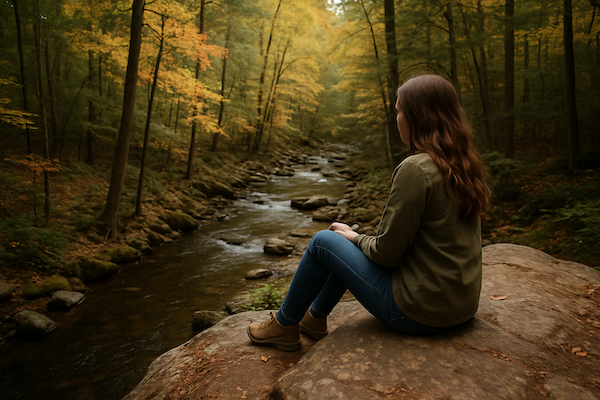
With a mix of emotions I began the journey toward the deep woods and lush meadows of Upper Bucks County, Pennsylvania: Penn’s Woods where James Michener and Pearl Buck found inspiration. And so did I as a young girl who spent countless hours on her “thinking rock”: A childhood place so special that I have called upon it in my darkest adult hours.
That jagged boulder that sat high above a gently rolling creek is the talisman that I have touched through an unpleasant divorce, the vagaries of a writing career, the onslaught of middle-age, and the death of a child.
As the roads narrowed from four lanes to two to having to pull over for an oncoming car, my own personal Brigadoon reappeared. Every curve was familiar. Every house once sheltered a friend. I stopped on an old access road at the edge of what was my family’s farm. The land had been altered by time and machine. But like an old friend that one hasn’t seen for a long time, the years fell away, replaced with images imprinted on my memory.
I walked through the fields that used to be white with buckwheat blossoms, up the hill where winter wheat turned green early in the spring, to the place where my childhood companion, Duke, is buried. The stones I placed as a marker when I was 14 are gone, but I whispered his name and felt him brush by me.
I headed into the woods, toward the cliff. It was still there, the same beautiful peaceful place where I sorted out my pubescent dilemmas and dreamed the dreams of a young woman, and convinced myself that I would have a wonderful life. It will always be there.
I remember something William Penn said, “Death is no more than a turning of us over from time to eternity”.
I believe that when life no longer becomes about time, when the tones of technology no longer mark the moments of my life, I will gladly turn myself over to an eternity that will set my spirit free to rest upon the thinking rock.